
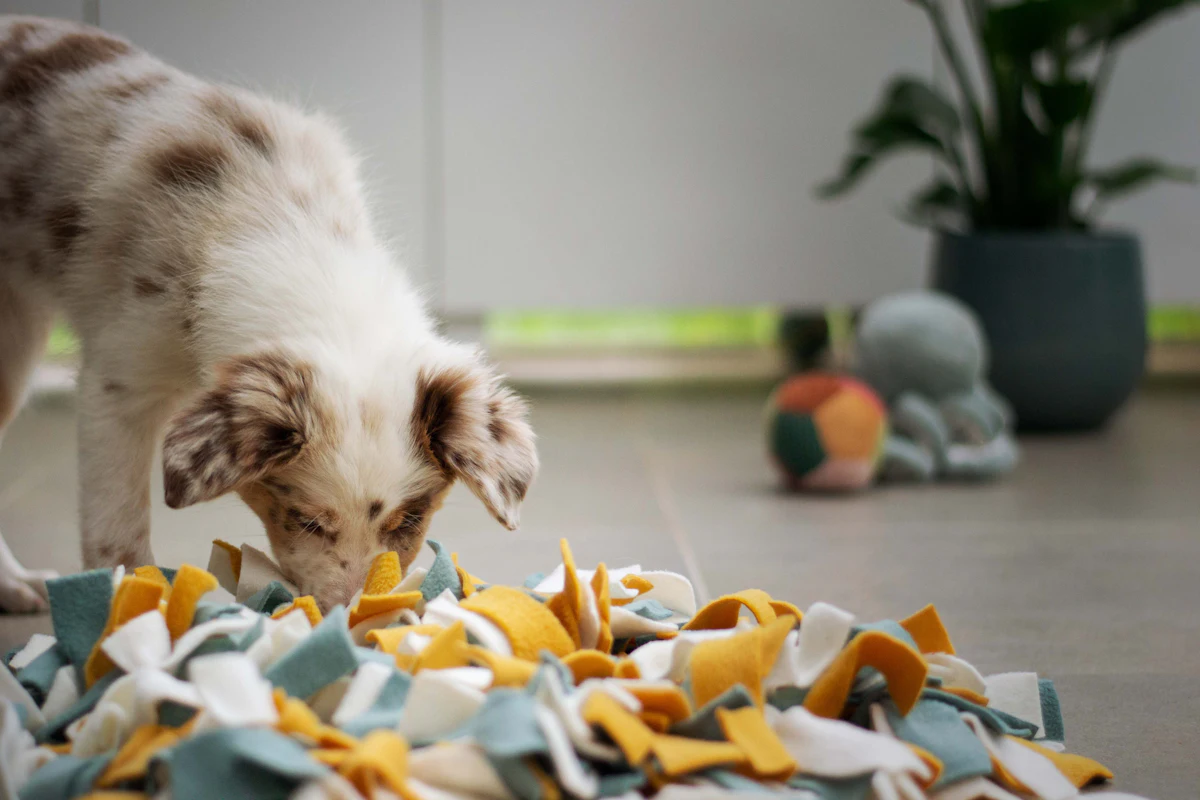
Quick answer: a DIY snuffle box for dogs is an open cardboard box filled loosely with plain paper or other safe lightweight materials, with food scattered between the layers so a dog can search using their nose.
It is cheap, quick to set up and easy to adjust. It is also a supervised activity because cardboard and paper are not designed as chew toys.
What you need
- One clean open cardboard box
- Plain packing paper or clean paper sheets
- Part of your dog’s regular dry food or suitable treats
- A non-slip floor area
How to make a DIY snuffle box
- Place the open box on a stable surface.
- Loosely crumple several sheets of plain paper.
- Add the paper without packing it tightly.
- Scatter a small amount of food where it is easy to see and smell.
- Invite your dog to investigate.
- Remove the box when the food is gone.
How to introduce it to a beginner
Keep most of the food near the top on the first attempt. You can even place one or two pieces directly on the box edge. The goal is to teach the dog that sniffing and moving the paper makes food appear.
How to make the game easier
- Use less paper.
- Keep all food visible.
- Use a shallow box.
- Let the dog watch you scatter the food.
How to make it harder
- Add more loose paper.
- Hide some food deeper in the box.
- Use two boxes, one empty and one with food.
- Move the setup to another room.
How long should a snuffle-box session last?
For most dogs, a short session is enough. Stop after the food is found rather than leaving the empty box available for chewing.
Who should skip this activity?
Do not use a cardboard snuffle box for a dog that aggressively eats cardboard or paper, becomes possessive around food activities or destroys materials so quickly that safe supervision is difficult.
Safer alternatives for cardboard chewers
- Sturdy food-dispensing toys
- Hard plastic puzzle feeders
- Scatter feeding on grass
- A commercial snuffle mat used under supervision
Common mistakes
Packing the paper too tightly
A beginner should be able to move material easily. Dense packing can make the activity frustrating.
Using too much food
Use part of a normal meal when possible so enrichment does not quietly add a large number of calories.
Leaving the box out afterward
Remove the setup when the search is finished. The activity should not turn into unsupervised cardboard destruction.
Can you reuse the box?
Yes, if it remains clean, dry and structurally safe. Replace it when it becomes torn, contaminated or damp.
How this compares with a snuffle mat
| Feature | DIY snuffle box | Snuffle mat |
|---|---|---|
| Cost | Very low | Purchase required |
| Main behavior | Searching and moving paper | Searching through fabric |
| Durability | Low | Usually higher |
| Best for chewers | Often no | Depends on dog |
| Cleanup | Discard or recycle | Washable |
Related guides
For more homemade activities, see DIY Dog Enrichment. For scent-work ideas, try 15 Sniffing Games for Dogs.
Frequently asked questions
Can I use newspaper in a snuffle box?
Plain clean paper can work for dogs that do not ingest it. Avoid glossy, heavily printed, dirty or contaminated materials, and supervise throughout.
Can I close the cardboard box?
For beginners, keep it open. Closing or sealing the box adds frustration and introduces tape or tearing risks that are unnecessary for the basic game.
Can puppies use a snuffle box?
Yes, with very easy setup and close supervision. Keep sessions short and remove the box as soon as the food is gone.
How much food should go in the box?
Use a small portion of a normal meal. The goal is searching, not increasing calorie intake.
Three difficulty levels
| Level | Setup |
|---|---|
| Beginner | Food on top of a few loose paper pieces |
| Intermediate | Food scattered through several loose layers |
| Advanced | Two open boxes with food divided between them |
Why this is a scent game, not a destruction game
The goal is for the dog to search with their nose and move lightweight material to reach food. If the dog switches to shredding and swallowing cardboard, end the activity and choose a more durable enrichment option.
How to troubleshoot common snuffle-box problems
My dog tips the whole box over
Use a wider, shallower box and place it against a wall or on a non-slip surface. Tipping is not necessarily a problem if the dog is still searching safely, but a more stable setup can keep food from scattering everywhere.
My dog ignores the box
Make the rewards more obvious. Place food directly on top of the paper, let your dog watch you add it and reward any calm investigation. Some dogs need several very easy sessions before they understand the game.
My dog shreds the paper instead of searching
End the activity and switch to a durable search option. If shredding is the behavior your dog wants, a different supervised enrichment activity designed around safe shredding may be more appropriate.
How to use a snuffle box as part of a meal
Divide a measured meal into two portions. Use one part in the snuffle box and serve the rest normally. This keeps the activity short and prevents the dog from needing to search through a large amount of material for every bite.
Snuffle box vs scatter feeding
Scatter feeding is simpler and better for dogs that cannot safely use cardboard. A snuffle box adds an extra problem-solving layer because the dog must move material to locate food. Both can be useful; choose the easier setup if safety or frustration is a concern.
Storage and cleanup
Discard damp, dirty or heavily damaged paper. Store reusable boxes somewhere dry and inaccessible to the dog. If food residue remains in the box, recycle or replace it rather than storing it for long periods.
A complete first-session walkthrough
Prepare the box before inviting your dog over. Put a small number of food pieces on top of the paper and a few just below the first layer. Place the box on a non-slip surface and stand nearby without repeatedly pointing at the food. Let the dog investigate, and praise calm searching. When the visible food is gone, lift the box away before the dog switches from sniffing to prolonged chewing.
On the second or third session, move a little more food below the top layer. That is enough progression for many dogs. There is no need to tape the box closed, stack multiple sealed boxes or create a complicated puzzle just because the easy version looks simple to a human.
Why simple food puzzles often work better for beginners
Preventive Vet’s guide to food puzzles makes an important point: people often conclude that a dog “doesn’t like puzzles” when the first puzzle was simply too difficult. A DIY snuffle box should avoid that problem by making success obvious at the start.
Supervision checklist
- Keep the box open.
- Use plain, clean, loose material.
- Remove tape, staples and labels that can peel off.
- Stop if the dog swallows paper or cardboard.
- Use a measured food portion.
- Remove the box when the search ends.
If any of those conditions are difficult to maintain with your dog, switch to scatter feeding or a durable purpose-built food puzzle.