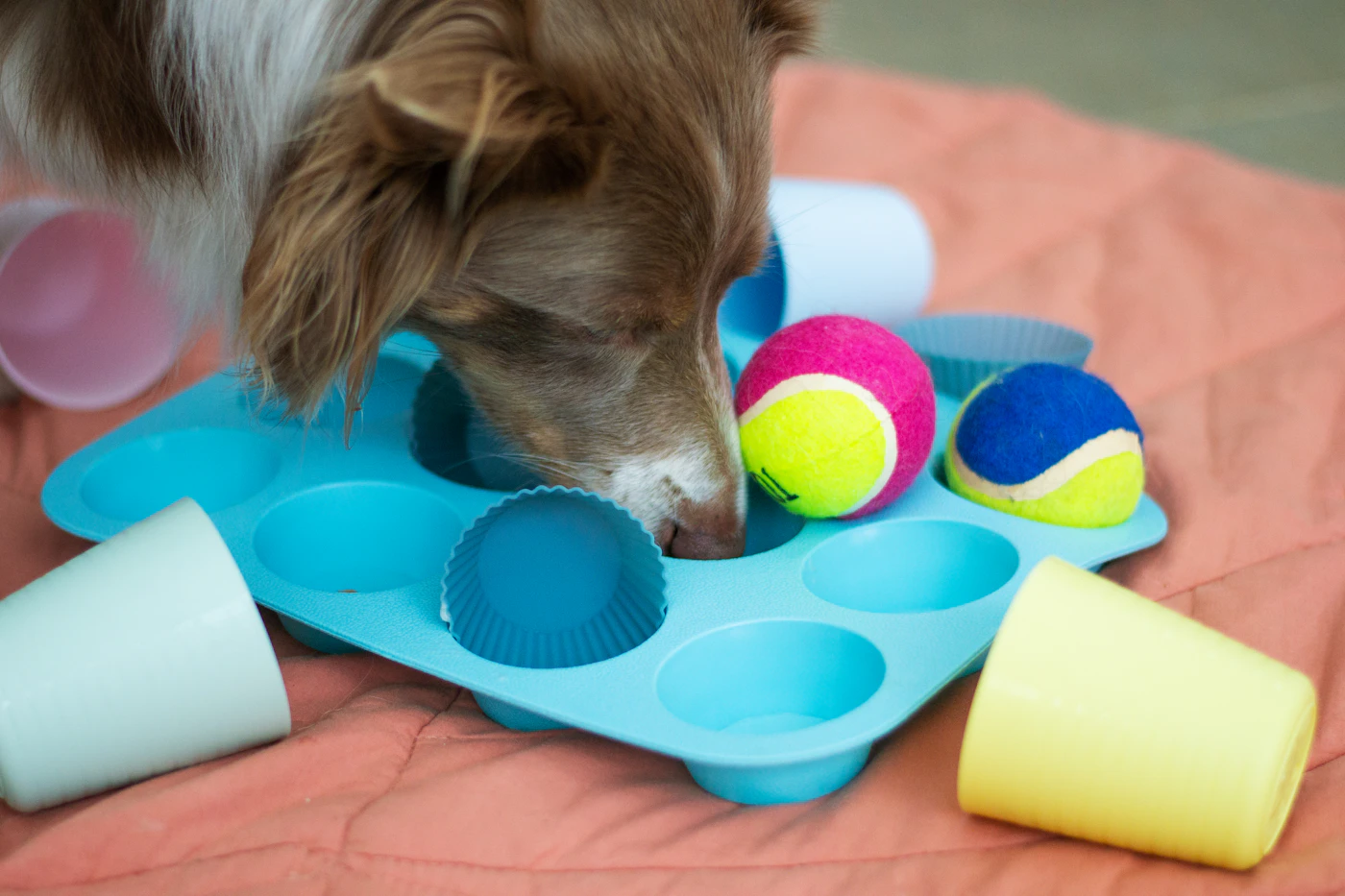

Quick answer: A muffin tin dog puzzle uses a clean, undamaged baking tray, a little measured dog food and optional dog-safe covers. Begin with food in uncovered cups. Only add a cover after your dog comfortably finds the food. Every cover must be too large to swallow and safe for that dog’s chewing style.
This is a simple household enrichment activity, not a test that needs twelve covered cups to count. You can use one cup, leave most of the tray empty or skip covers entirely. The useful part is an achievable search that your dog can complete without biting metal, swallowing objects or becoming frustrated.
What makes this a puzzle?
The tray separates food into small locations. Adding a safe, movable cover introduces another action: the dog must notice the food and move something to reach it. Sniffing, selecting and manipulating can turn a portion of a meal into a brief foraging task.
The ASPCA includes a muffin-tin activity among its homemade food-enrichment ideas. The basic concept is uncomplicated. What matters in practice is matching the tray, covers, food and difficulty to the individual dog.
Do not assume a dog who ignores a covered cup lacks problem-solving ability. They may dislike metal sounds, prefer playing with a ball, find the food uninteresting or simply not understand that a cover can move. Your setup creates the challenge; you can change it.
A muffin tin dog puzzle is different from the cardboard snuffle box already in our library. This guide focuses on a washable, reusable tray with separate wells and explicit cover-safety decisions.
Check the equipment before adding food
Choose a tray with smooth edges and no rust, sharp damage, flaking coating or loose components. It should sit securely on the floor and not tip when the dog investigates. Do not use a hot tray or one containing cooking grease, food residue or cleaning-product residue.
Check the cup depth against the dog’s muzzle. A dog should be able to reach food without pressing their face awkwardly into a narrow space. A shallow tray may work better than deep muffin cups for some dogs. If access looks uncomfortable, choose another feeder.
Use a non-slip mat beneath the tray. A sliding, rattling pan can turn a gentle puzzle into a noisy chase. Avoid placing it near stairs, a furniture edge or a route used by children.
Covers are optional. Only use intact dog toys that cannot be swallowed and are appropriate for the dog’s mouth and chewing strength. A ball that neatly fits a baking cup is not automatically safe. Small balls, marbles, stones, bottle caps and loose household pieces are unsuitable.
The RSPCA’s low-cost enrichment guidance offers household puzzle concepts. Apply an individual safety check rather than copying a ball size from a photograph. If no safe cover fits your tray, leave it uncovered.
Who should skip this activity?
Do not offer the tray to a dog who chews metal, swallows toy parts or grabs and gulps loose objects. Dogs who guard food or toys may need a professional management plan before a person can safely set up and remove a puzzle.
Be cautious with dogs who find household noise frightening. Begin with the empty tray at a distance and reward voluntary investigation, or use a quieter alternative. Do not lure the dog so close that eating depends on tolerating something frightening.
Medical diets, dental problems, swallowing difficulties and mobility limitations can affect suitability. Discuss those concerns with your veterinarian. An enrichment game should adapt to a dog’s health, not require them to work around discomfort.
Build a muffin tin dog puzzle in seven steps
Set up while the dog is comfortably elsewhere, then invite them to approach. Work through these stages over as many sessions as needed. There is no requirement to reach the final stage.
Step 1: Measure a small food portion
Set aside a little of the dog’s normal food when appropriate. Start with familiar food rather than a large variety of new ingredients. Count any extra treats within the day’s intake, and keep special diets unchanged unless your veterinarian approves additions.
Use food the dog can easily pick up. Very small crumbs can lodge in corners, while oversized pieces may not be suitable for that dog. You want easy access, not a puzzle whose main difficulty is eating.
Step 2: Introduce the uncovered tray
Put a few visible pieces in one or two open cups. Let the dog approach and collect them. Remain nearby without tapping the tray repeatedly or pushing the dog’s nose toward it.
Watch posture and movement. Is the dog relaxed? Does the tray stay still? Can they reach without scraping teeth against metal? If the answer is no, change the tray or activity before adding a cover.
Step 3: Spread food across a few wells
Once the dog understands that cups may contain food, use several separated wells. Keep the number modest. Let them investigate each location rather than directing every movement with your hand.
This stage is already a valid activity. Some dogs enjoy an uncovered search and have no need for another challenge. You can repeat it with small changes in which cups contain food.
Step 4: Partially cover one cup
Choose one suitable cover and position it so food remains partly visible or the cover is very easy to move. Keep other food accessible in open cups. The dog can succeed even before solving the new feature.
If your dog is unsure, move the cover slightly yourself and let them collect the food. Avoid waiting through escalating barking or biting. A clear demonstration can be more useful than making the dog struggle.
Step 5: Cover one well fully
Only after the partial cover is easy, place it over one food-filled well. Use an object the dog can move without biting metal or getting their mouth stuck. Keep nearby wells open so the puzzle does not suddenly become all-or-nothing.
If your dog picks up the cover to play, that is a preference to respect. You can have a short toy game and return to uncovered food later. Do not repeatedly snatch the object away.
Step 6: Vary placement rather than adding every cover
Move the covered well to a different position or use two easy covers separated by open wells. Keep the total food amount similar. Change one feature so you can see how the dog responds.
A tray with every cup covered may be unnecessary and harder to supervise. More objects also create more opportunities for chewing and guarding. Keep the setup at the simplest level that remains interesting.
Step 7: End clearly and inspect everything
When the planned food is gone, invite the dog away with a familiar cue or a small reward delivered elsewhere. Collect the tray and covers when you can do so safely. Check every object for damage and recover all pieces.
If the dog keeps returning to the tray, show the finish consistently rather than leaving it available for unsupervised investigation. Wash, dry and store the equipment out of reach.
Choose a level by the dog’s response
Use this table as a setup guide, not a ranking system. A dog who enjoys the first level does not need to graduate. Clear access can be especially useful for puppies, older dogs and cautious beginners.
| Setup | What the dog does | When to use it |
|---|---|---|
| One uncovered cup | Finds visible food | First introduction |
| Several open wells | Checks different locations | Comfortable beginner |
| One partial cover | Notices food under an edge | Introduction to moving an object |
| One easy full cover | Moves one safe toy | Relaxed, successful learner |
| Two separated covers | Makes a small sequence of choices | Dog who remains comfortable |
Increase interest through location changes, brief training between setups or a different familiar food portion—not just through tighter covers. Never wedge covers in so the dog must use force.
Observe whether your dog is actually solving the food task or simply trying to dismantle equipment. The latter is a reason to stop, not evidence that the puzzle needs a tougher version.
Troubleshooting a muffin tin dog puzzle
Most problems can be addressed by removing a demand. Start with fewer objects, more visible food and less noise before adding anything new.
My dog only wants the balls
Separate ball play from the feeding activity. Offer an uncovered tray after a short, controlled play break, or choose a different safe cover. It is also fine to use another kind of puzzle entirely.
My dog tips or carries the tray
Use a stable, non-slip setup and check whether the cup depth makes food inaccessible. If carrying or tipping persists, stop using the tray. Do not hold it down near the dog’s mouth while they wrestle with it.
My dog barks at the covered food
Reveal the reward and return to an easier stage. Barking may indicate frustration or another unmet need; it is not a reason to cover more cups. Reduce the time spent waiting for a solution.
My dog bites the metal
End the activity and use a suitable feeder instead. Metal biting can create injury risk, and a baking tray is not a chew toy. Do not expect repeated exposure to make this behavior safe.
My dog is afraid of the rattling
Remove covers and place the tray on a secure mat, or switch to a quieter option. Give the dog space. If they avoid the tray even before food appears, an open scatter may offer the same foraging opportunity without that concern.
My dog finishes almost immediately
A quick, calm success can be useful. You do not need to make every feeding activity last a long time. Combine a short search with another appropriate activity from our DIY enrichment guide.
Adapt the game for different dogs
For a puppy, begin with one shallow uncovered well and a few pieces of normal food. Monitor mouth behavior closely and keep the session brief. Puppies who grab objects need alternatives rather than more cover training.
For senior dogs, consider comfortable height, footing, vision and muzzle access. A tray on the floor is not suitable if bending causes discomfort. Do not improvise an unstable elevated stand; ask your veterinarian about appropriate feeding positions.
For flat-faced dogs or dogs with broad muzzles, shallow access may be essential. If food is difficult to reach, change equipment. The aim is mental engagement, not a physical challenge created by the shape of the tray.
In multi-dog homes, use separate spaces. Multiple wells do not make a single tray a safe shared puzzle. Allow each dog to finish without another dog approaching or competing for covers.
Clean food equipment after use
Remove leftovers and wash the tray and washable covers with appropriate detergent, then rinse and dry thoroughly. Follow each toy’s cleaning instructions rather than assuming every rubber or fabric cover is dishwasher-safe.
The FDA’s safe pet-food handling advice recommends cleaning feeding equipment and handling leftovers promptly. If wet food is used, follow its storage label; do not leave residue in a baking tray between sessions.
Store the tray with its covers separately from the dog’s normal toy access. Inspect before the next session, even if the previous game was gentle. A chewed cover or damaged edge changes the safety assessment.
Frequently asked questions
Do I need a twelve-cup muffin tin?
No. Use a suitable tray you already have, and fill only a few wells. The size should fit the available space and allow comfortable food access. A small, simple setup is often easier to introduce and clean.
Can I use ping-pong balls for a small dog?
This guide does not recommend small loose balls as covers. An object must be too large to swallow and suitable for that dog’s mouth and chewing behavior. If safe covers do not fit, leave the wells open.
Can I leave it out while I work?
Only if you are actively watching the interaction and can respond safely. This is not an unsupervised feeding recommendation. Put the equipment away when you cannot monitor it or once the food is finished.
Is it a substitute for a slow feeder?
It can change how a food portion is accessed, but it is not a medical solution for fast eating or digestive problems. Ask your veterinarian about feeding concerns. Some dogs may need a purpose-designed feeder instead.
What if my dog dislikes the tray?
Respect that response. Try a plain food scatter, a suitable commercial puzzle or a sniffing game. Household enrichment should add suitable choices, not make a dog tolerate an unpleasant object.
Start with an uncovered cup
The most useful first attempt is also the easiest: a stable tray, a few visible pieces of food and a dog who can investigate comfortably. Add a single safe cover only if it improves the experience. Keep what works, remove what does not and finish with clean equipment.
Editorial note: This activity is for general education and requires individual safety assessment. Loose objects can create choking or obstruction hazards. Seek veterinary help promptly if you suspect ingestion, dental injury or illness.