
Quick answer: To teach your dog toy names, begin with one safe toy and one consistent label. Reward a simple interaction, build a reliable response to that label, and only then introduce another toy. Change the toys’ positions so your dog is not merely choosing a side. Keep practice short, positive and free of pressure.
This is a small-space learning game, not a test of whether your dog is clever. Some dogs find objects fascinating; others would rather sniff, chase or spend time with you. You can make the game rewarding without expecting a huge vocabulary, a perfect retrieve or the rapid learning sometimes seen in exceptional dogs.
What this game teaches—and what it does not
There are several skills hidden inside “get your ball.” Your dog must attend to a sound, identify the requested object, move toward it, pick it up and perhaps return it. If you train all those pieces at once, it becomes difficult to tell which part needs help.
Separate identifying from retrieving. A nose touch can show which toy your dog selected. Carrying the object back is optional and can be taught later. This makes the first sessions accessible to dogs who do not naturally fetch or have difficulty carrying a particular toy.
The AKC toy-name guide recommends consistent labels and gradual progression. Research on exceptional word-learning dogs should not become a deadline for an ordinary family pet. The AKC overview of gifted word learners explains that unusually fast object-name learning is not typical of every dog.
Instead of promising a number of words, use a practical goal: your dog enjoys a short session and makes increasingly clear choices between familiar objects. That can be worthwhile even if you stay with two toys.
Choose toys, words and rewards carefully
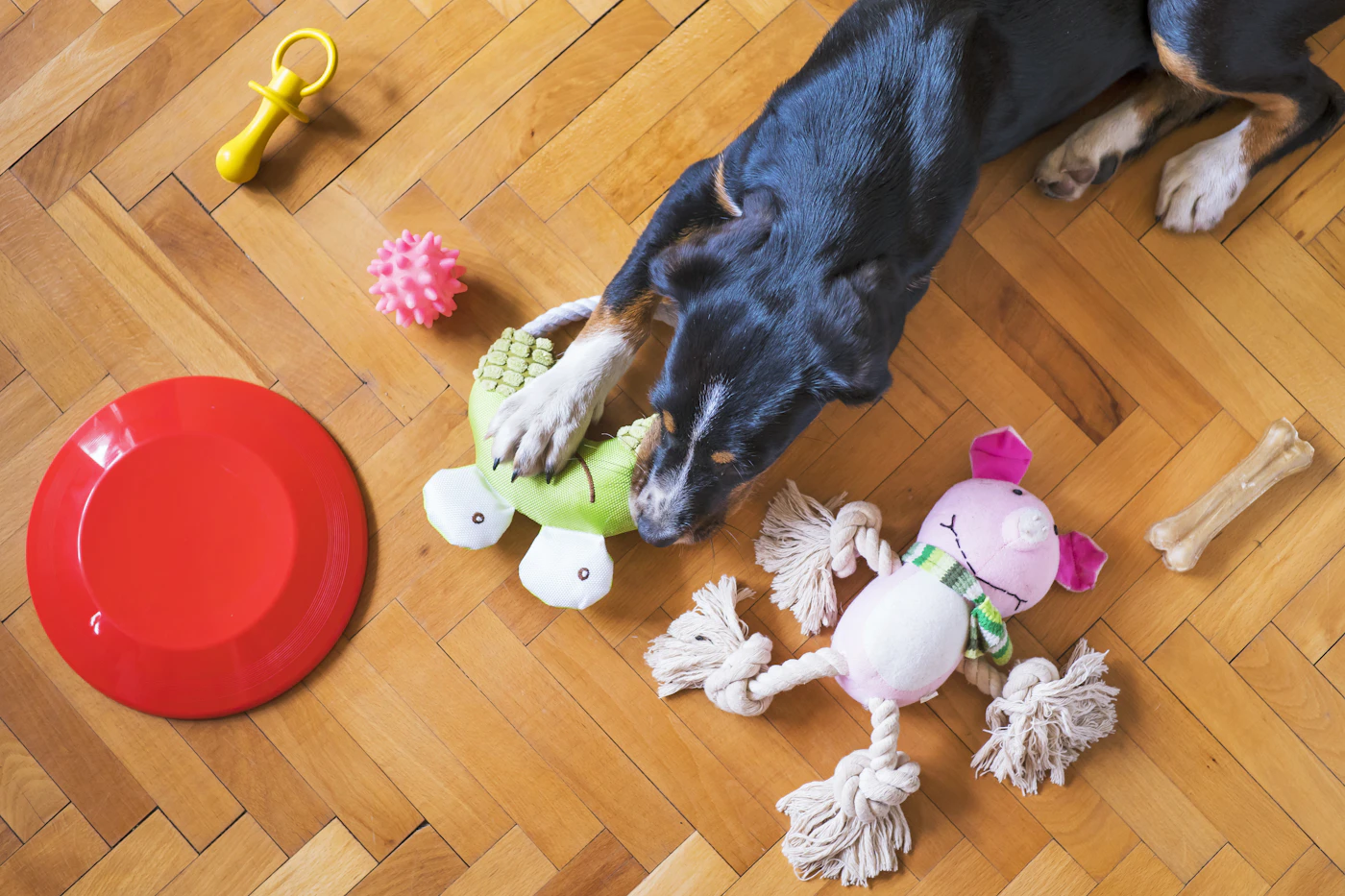
Use two toys that are safe for your dog’s size and chewing style. Pick objects that are easy to distinguish physically, such as a soft bear and a large rubber ball. Avoid loose pieces, damaged fabric and toys your dog guards. Keep all unused toys out of the training area.
Choose short labels that sound different. “Bear” and “rope” are easier to keep distinct than two very similar-sounding names. Agree on the labels with everyone involved. Calling the same object “ball,” “tennis” and “yellow thing” adds unnecessary ambiguity when you are building an association.
Have a reward ready. For a toy-loving dog, a brief play session with the selected item may be valuable. Another dog may prefer a small food reward. Use part of a measured meal where appropriate and count treats in the daily intake. Do not withhold normal meals to make the dog participate.
Practice in a quiet, non-slip area. Keep your hands neutral during choice trials and avoid hovering over the correct toy. A dog may follow your gaze or reaching motion rather than the word, which is useful information—not misbehavior.
Teach your dog toy names in seven steps
Work through these stages at the dog’s pace. They do not have to happen in one session or one week. Your own notes will be more helpful than an arbitrary training schedule.
Step 1: Decide what a correct answer looks like
Choose one response you can clearly recognize: touching the toy with the nose, picking it up or bringing it to you. A nose touch is often the simplest starting point. Reward it several times without asking for extra behaviors.
If your dog already retrieves enthusiastically, you can use that response. If they grab and run away, start with a low-pressure touch while the toy remains on the floor. Do not chase them to recover the training equipment.
Keep your reward timing consistent. A marker such as “yes” tells the dog exactly which moment earned the reward, but use it only if the dog already understands it. Otherwise, calm praise and prompt reward delivery can keep the setup straightforward.
Step 2: Build interest in one object
Put the selected toy a short distance in front of the dog. Reward looking at or investigating it, then ask for the chosen interaction when it becomes easy. Remove the toy briefly between repetitions so each attempt has a clear beginning.
Use a toy the dog can approach comfortably. Some dogs dislike noisy squeakers or unfamiliar textures. Trying another object may solve the problem more effectively than using higher-value food to encourage contact with something they avoid.
Step 3: Pair the label with the familiar action
Once the dog reliably interacts with the toy, say its label just before presenting the opportunity. For example, say “bear,” place the bear within easy reach and reward the agreed response. Keep your wording the same.
Avoid repeating the word continuously while the dog wanders. One clear cue followed by an achievable opportunity is easier to interpret. If there is no response, reset, make the object more accessible and check whether the dog still wants to play.
You are building an association through useful repetitions, not explaining the word in a sentence. Keep conversation between trials separate from the brief cue used for the task.
Step 4: Check the cue in different positions
Move the single toy from the middle to your left, then to your right. Change its distance only a little. Ask for the same response and reward success. If the dog cannot find it in a different position, return to the easiest placement.
This step checks whether the routine depends heavily on one familiar picture. It does not yet prove word understanding, because there is still only one toy. That is fine: you are reducing location dependence before adding a meaningful choice.
Step 5: Teach the second toy separately
Put the first object away and introduce the second using the same gentle process. Use a clearly different label. Keep sessions for the two objects separate at first so the dog has a chance to build each association.
Do not switch back and forth too quickly if responses become hurried or confused. One toy per short session is a perfectly reasonable format. A successful return to an easier task is progress in keeping learning comfortable.
Step 6: Offer a two-toy choice
Place both familiar toys a comfortable distance apart. Ask for one label, then allow the dog to choose without pointing. Reward the agreed response to the requested object. Remove both toys and reset before the next attempt.
Alternate requests and change the toys’ left-right positions. Avoid asking for the same object every time, which may simply reinforce a favorite. If the dog selects the other toy, remain neutral and set up an easier trial; do not scold or repeatedly say “no.”
If two-toy choices create repeated mistakes, return to separate practice. You can also increase the space between toys or choose objects with more distinct appearances and textures.
Step 7: Add distance or a third object—not both
When two-object choices are comfortable across several positions, change one thing. Stand slightly farther away, use another familiar room or teach one additional label in separate practice. Keep the rest of the task easy.
Only add a search component after identification is reliable. Sending a dog into another room adds memory, searching, distance and possibly a retrieve. That is a much larger jump than moving the toys a foot apart.
The finish should still feel like play. Say a consistent end phrase, put the training toys away and offer a normal break. You do not need to keep testing until the dog makes an error.
Use simple notes to distinguish progress from guessing
A small log helps you notice patterns that memory misses. Record the requested object, its position, the dog’s first clear choice and any extra help. Mark a trial as prompted if you pointed or moved toward the answer.
| Trial | Requested toy | Position | First choice | Help given |
|---|---|---|---|---|
| 1 | Bear | Left | Bear | None |
| 2 | Rope | Left | Bear | None |
| 3 | Rope | Right | Rope | None |
| 4 | Bear | Right | Bear | Pointed |
This example is a recording format, not a result from testing a dog. You are looking for consistency across positions, not a single impressive choice. Four successful attempts on one side may mean the setup is predictable.
Use patterns to change training, not to grade the dog. If accuracy falls late in a session, shorten the next one. If one toy is always selected, practice the other independently. If performance changes between rooms, return to the familiar context and add novelty gradually.
Troubleshooting common toy-name problems
To teach your dog toy names comfortably, make mistakes informative. The question is usually which part of the task became unclear, not whether the dog is refusing to cooperate.
My dog always chooses the same side
Switch the toys’ positions between attempts and move your own body slightly. Check whether you look, lean or reach toward one object. Keep the starting distance short. Return to single-toy placement changes if side preference persists.
My dog always chooses a favorite toy
Practice each toy separately and check the reward. If one toy starts a thrilling tug game while the other earns little interest, the choices are not equally rewarding. Reward correct responses to either object with something your dog values.
My dog retrieves but does not release
Train a separate trade without turning toy naming into a contest. The AKC drop-it guide provides a reward-based starting point. For this game, you can temporarily accept a nose touch so release does not block progress.
My dog looks at me instead of the toys
Make the requested interaction more obvious and reward closer to the object. You may have a well-practiced attention behavior competing with a new task. Go back to rewarding investigation without repeatedly adding the label.
My dog is not interested in toys
Choose an object they already enjoy and reward a very small interaction. There is no need to force a retrieve. If toy play remains unappealing, try sniffing games or other forms of mental stimulation instead.
My dog growls when I approach a toy
Stop the game and avoid reaching in or taking the object by force. Guarding changes the safety requirements. Seek help from a veterinarian or qualified reward-based behavior professional before using valuable toys in close-contact training.
Keep learning humane, brief and age-appropriate
AVSAB’s humane training guidance supports reward-based methods. Toy naming should not involve leash corrections, intimidation or physical manipulation of the dog’s mouth. Make the right response achievable and reward it.
Puppies can investigate safe objects and practice very short associations, but they do not need a vocabulary project. Senior dogs may prefer large, easy-to-see toys and a simple nose touch. Dogs with dental or mobility concerns need comfortable response options.
Do not compare dogs or breeds using your training log. Differences can reflect toy interest, prior learning, hearing, vision, stress, reward value or the task design. Sudden changes in engagement or ability deserve veterinary attention.
Turn the skill into everyday enrichment
Once two labels are familiar, ask for a toy before a short play session. Keep it easy enough that the word predicts something pleasant. You can occasionally change where toys are placed without turning every interaction into a formal trial.
Another option is a simple toy shelf or basket with only two familiar items. Ask for one, play briefly, then finish. Avoid building an overwhelming pile merely to make the game look impressive.
Connect the activity to a balanced dog enrichment routine. Toy naming is one kind of learning, alongside scent work, suitable movement, safe chewing, social contact and rest. A few enjoyable repetitions can be enough for that moment.
Frequently asked questions
How long does it take to teach a dog toy names?
There is no dependable timetable. Some dogs quickly form useful associations; others need many short sessions or prefer different activities. Judge progress across easy, varied setups rather than expecting a word after a fixed number of repetitions.
Does my dog have to fetch?
No. A nose touch or another clear interaction can identify the selected object. Retrieving adds carrying, returning and releasing. Teach those separately if you want them, rather than making every response depend on a complete fetch.
Should I use treats or the toy as a reward?
Use what your dog values and what keeps the session manageable. Play may reward a toy-loving dog; food may help a dog who enjoys the task but not tug. Rewards can vary without changing the object’s name.
Can I use two identical balls?
Distinct objects make beginner choices easier to interpret. Identical objects may be distinguished through other features, but they add an unnecessary complication. Start with different shapes and textures, then consider whether any further challenge benefits your dog.
A useful first session
Choose one safe object and one label. Reward a few comfortable interactions, record what happened and finish with a brief activity your dog likes. Tomorrow, repeat the same easy setup before adding anything new. The aim is a shared game that stays enjoyable, not a growing list of words at any cost.
Editorial note: This is an educational training guide, not an assessment of canine intelligence or a treatment plan for fear, aggression or guarding. Consult an appropriate professional when safety or behavior concerns affect play.